retro-kit 0.2.0 brings DirectX and MSVC games into its Ghidra pipeline
retro-kit 0.2.0 adds Win32 support: DirectX calls with method names, typed middleware imports, and C++ classes from MSVC RTTI.
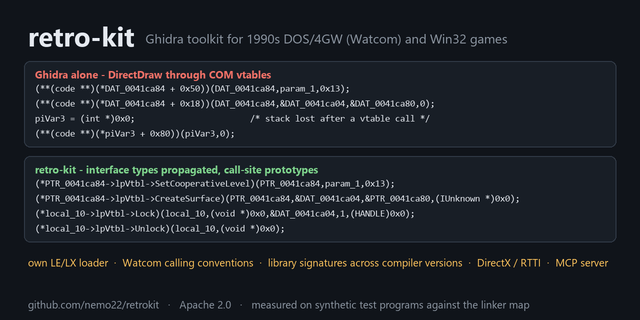
retro-kit 0.2.0 adds Win32 games to the list. The release came out October 14 and covers DirectX and C++ titles from the late 1990s and 2000s. The toolkit drives Ghidra, a reverse engineering framework, in headless mode, meaning no GUI. Until now the focus was DOS games built with Watcom.
DirectDraw 1-7, DirectSound, DirectInput 1-8 and Direct3D 3-9 calls now come out with method names. The decompiled C reads (*g_dd->lpVtbl->CreateSurface)(g_dd,&desc,&g_primary,0) instead of raw pointer math. Miles, Smacker, Bink, FMOD and BASS imports get typed. retrokit classes pulls MSVC C++ classes, base classes and vtables out of RTTI. The Rich header gives the compiler version, such as VC++ 6.0 or VS 2005.
The output is readable C. It does not do matching decompilation or static recompilation. Original Watcom compilers for DOS games are rarely around, so byte-matching is usually off the table there. The author says the named analysis could feed a matching effort if someone has the original compiler, and asks which format would help, objdiff-style projects for example.
To try it:
- Install Ghidra 12.x, JDK 21+ and Python 3.10+.
- Run
pipx install git+https://github.com/nemo22/retrokit@v0.2.0. - Run
retrokit doctorto check the setup. - Run
retrokit analyze GAME.EXE.
For a hobbyist, it is a starting point for understanding a Windows-era game or writing a port.